Samstag, 27. Mai 2017

Nikon Nikkor Ai 50mm f/2.0 - a miracle weapon on all cameras


On my endless search for really cheap lenses with good to excellent picture quality I came across the net on many good reviews on the Nikkor Ai lenses. Okay, many of these lenses have become really expensive now. Sometimes the difference between the current Nikon AF-S lenses and their partial ancient predecessors has become marginal. Right bargains are very rare.
Always very good and inexpensive are the most (not so fast) zooms of the Ai-era and the fixed focal lengths of the cheap "Nikon e-series".
For the beginning I have selected the following lenses for review: the Nikkor Ai 50 f/2.0, the Nikon e-Series 28mm f/2.8 and the Nikon e-Series 100mm f/2.8. Let's see if it will end up a few more.
Let's start with a few lenses from the Nikon range. Specifically with the not very fast 50 mm with the initial aperture of 2.0. Faster goes with Nikon in any case, there are besides the super expensive 1.2er lenses also still with an initial aperture of 1.4 and 1.8.
In many lens makers, the apertures of 2.0 are reserved for photographers who want to shoot with 100% sharp images with a dream-changing security even in the case of a complete open aperture. There is the legendary Zeiss T Planar or the Leica Summicron as expensive and splendid examples. The Zeiss Planar 50mm f/2.0 i very often and gladly use on my Leica M, rather than the faster Voigtländer Nokton 50mm f/1.5. I am not ashamed to assert myself, that the wide open Nikon Ai 50mm f/2.0 is just as good as the Zeiss Planar with open aperture. And you have to get this as a manufacturer for this price.
This amazing Nikkor 50mm f/2 AI was produced from 1974 to 1979. You can use it at FX, DX and 35mm coverage. I've tried it on my Nikon D610 and adapted on the Sony a6000. The results were outstanding on both cameras, FX or DX-sensors. 

But, as usual, we start with the technical data:

Optics: 6 elements in 4 groups.
Coating:  multicoated
Diaphragm: 6 straight blades.
Close Focus: 1.5'  or 0.45m
Filter size: 52mm
Construction: all metal, metal mount, metal focus ring, metal aperture ring
Weight: 7.8 oz. or 220g
Aperture scale: f/2 - f/16
Dimensions: 63.5mm diameter x 53mm long
Lens hood: Snap-On metal hood (HS-6), rubber screw-in (HR-1 )
Serial Numbers have been started from 350001
Exposure measurement: via full aperture method; meter coupling ridge provided for Al cameras and meter coupling shoe for non-AI cameras
(Source: www.mir.com, www.KenRockwell.com)


The Nikkor Ai 50mm is good to get on the market, you can buy it on different platforms on the net, but also on flea markets it is often offered. Prices for used lenses vary somewhere between 30 and 80 Euros. However there are also dealers, for example on EBay which offers it for outrageously overpriced prices. I've already seen it for 200, - Euro on offer. But you do not have to buy that.
I bought my copy in a photographer's forum for forty Euros. This is not exactly a bargain, but you can take it for this price.
The lens is pleasantly light and compact, on a full-size camera it is unobtrusive and looks almost like a pancake. It feels good and can be used excellently. The mechanical design is almost the same for all Ai-Nikkors, if you know a lens you know almost all.
Even with the massive Ai adapter is the lens on the Sony a6000 pleasant to use. 
The Nikkor shows an extremely high performance, also on open aperture. The sharpness is excellent.
On my D610, the 50mm f/2 AI is always sharp edge-to-edge. The images are sharp at f/2. however there's veiling from spherical aberration which lowers contrast. This is greatly improved by f/2.8, and contrast is perfect at f/4 and smaller.
The distortion is very small, lightly curving. Almost not to see.
A little bit of vignetting at f/2 on full-size cameras which quickly clears off at f/2.8. On my Sony a6000 is not to see from vignetting.  In the backlight, the NIkkor is somewhat sensitive, a lenshood is recommended for this lighting situation. Look at the photo below. The bokeh is unhappily a little bit poor and busy. 


The bottom line: A great lens. Very cheap, very well built, and with excellent image quality. Usually for photographers who are looking for a good fixed focal lengths with very little budget. Ideal for adapters who are looking for a truly exceptional and excellent normal focal length. It is not so fast, but very useful at open aperture. From me an absolute recommendation.
Here are a few photos I've shot over the last few weeks with the Nikkor:


Samstag, 6. Mai 2017

Meyer-Görlitz Primotar E 50mm f/3.5 - this lens you must have


Meyer-Optik is the brand name of an optical company from Germany. Meyer-Optik was before the Second World War as well as later as VEB Feinoptisches Werk Görlitz and as a part of the Kombinat VEB Pentacon Dresden a major manufacturer of camera lenses.
The Meyer-Görlitz Primotar 50mm f / 3.5 (Primotar = Vierlinser, that is the arrangement of the lenses in four groups) was produced in the years 1948 to 1958. My specimen is silver (made of aluminum) was manufactured in the year 1957 in two versions: as a lens with M42 bayonet and with Exakta bayonet.
The lenses are single coated. It is not particularly bright with an initial aperture of 3.5.

Let us take as usual the statistical data :

Optical design: 5 elements in 4 groups
Aperture blades: 6  (not rounded)
Apertures: f/3,5 to f/16
Closest focusing distance: 45 cm (last marking on the focus ring is 0,5 m = 1,7 ft.)
Length: 43 mm (1,7")
Weight: 173 gr. (6,2 oz.)
Filter thread: unusual 40,5 mm


The lens is made of full metal like a tank and has a very nice feel.  Because of its age, many copies have some problems with the operation of the focus and aperture rings. Many copies are blackened by oxidation, the labels are abraded. Fortunately, my specimen is in excellent external condition. The operation of the lens is somewhat difficult because of the narrow front aperture ring. 
The aperture ring otherwise is running smoothly and silently without clack- good for filming.
Because of its age and the starting aperture of f/3.5, the lens is in these days available from 30 to 50 euros.
We come to the most important thing: the picture quality.  The lens provides very sharp images even when the aperture is fully open. Especially in the center of the image contrast and resolution are excellent. To the outside, sharp corners are only reached from aperture f/8.  For an objective of this age, this is an extraordinary result. Since the front lens is sunk very deeply in the lens tube, backlight does not create any major problems, a lens hood is rarely necessary in my opinion.
The bokeh is very soft and creamy. Although the lens is not so fast, the photographer can easy free objects and people against a blurred background.
From my site, I can recommend any photo enthusiasts to adapt this lens. Provided you get it at a good price.
Here are some photos that I have shot in the last week with this lens:


Dienstag, 25. April 2017

Exakta MC Macro 24mm f/2.8 - a cheap and excellent wide angle lens


"Exakta" was originally and for many years a registered trademark of the Ihagee-Kamerawerke Frankfurt/Main. After the bankruptcy of Ihagee-Kamerawerke AG, the brand name "Exakta" was sold to Japan. Cosina has mainly produced the optical calculations of old lenses under this name and sold them all over the world.  For a number of years, the photo-shop "Porst" has also offered lenses under the name "Exakta" on the German market.
Especially this lens was manufactured in the mid-80s by Cosina and sold under various brands, like Vivitar, Exakta and Carl-Zeiss Jena. It was produced according to my research with various bayonets: M42, Olympus OM, Minolta SR, Canon FD and Pentax PK.  In addition, it is the same as Cosina MC 24mm f/2.8.  More information can not be found on the Internet about this lens.

Let us first come to the statistical data:

Mount: various, like M42 or PentaxPK a.s.o.
Lens construction: unknown
Closest focus distance: 12 cm (in Macro-position), otherwise 19 cm
Macro magnification 1 : 4
Number of diaphragm blades: 5
Weight: 161 gramm / 5,7 oz.
Length: 43mm / 1,7 inch
Filter size: 52mm
Apertures: 2.8 to 22


The lens feels very valuable, it is made of metal and solid. Aperture and focus ring work smoothly and without mechanical problems. Without an adapter, the lens is compact and lightweight. On my Sony a6000 it works with the massive PK adapter already slightly topheavy.
You get this lens under different brands, but the same optical quality often buy on flea markets or on Ebay. The prices are very different and usually vary between 20 and 60 euros. This is very favorable for a wide angle. For use on different system cameras you can buy simple adapters on the Internet. I have been using adapters from China for many years. These are very cheap - about 10 to 20 euros - and of excellent quality.
With a focal length of 24mm you do not have to worry about the possibility of shaking. Even with exposure times around 1/30s the photos are sharp.  Provided the optics are good and perfectly calculated. This is exactly the case with the Exakta 24mm f/2.8. 
When the aperture is open, the sharpness in the center is already very good, even if the picture impression has a little contrast and milky. To the edges of the picture, the photo becomes quite blurred and uneasy. The image quality improves with a slight stopped down. The sharpness is outstanding from aperture 5.6.  The optical performance is above all doubt for this price.
Distortions are not too disturbing despite the wide angle and can easily be corrected in Photoshop or Lightroom.
Stopped down to f/11 can produce very nice star effects. Note the resolution and sharpness at this 100% crop.


One disadvantage is the Exakta 24mm however: it is extremely sensitive with backlight. I am not aware of whether the lens originally enclosed a lens hood. But it should not be difficult for the filter size 52mm to find a lens hood to screw in.


The Bokeh is very quiet and pleasant. Overall, a truly recommendable and inexpensive wide-angle lens that can be used as an excellent walk-around lens on an APS-C sensor.
Here are some pictures taken with the Exakta 24mm f / 2.8 in the last few weeks:


Donnerstag, 9. Februar 2017

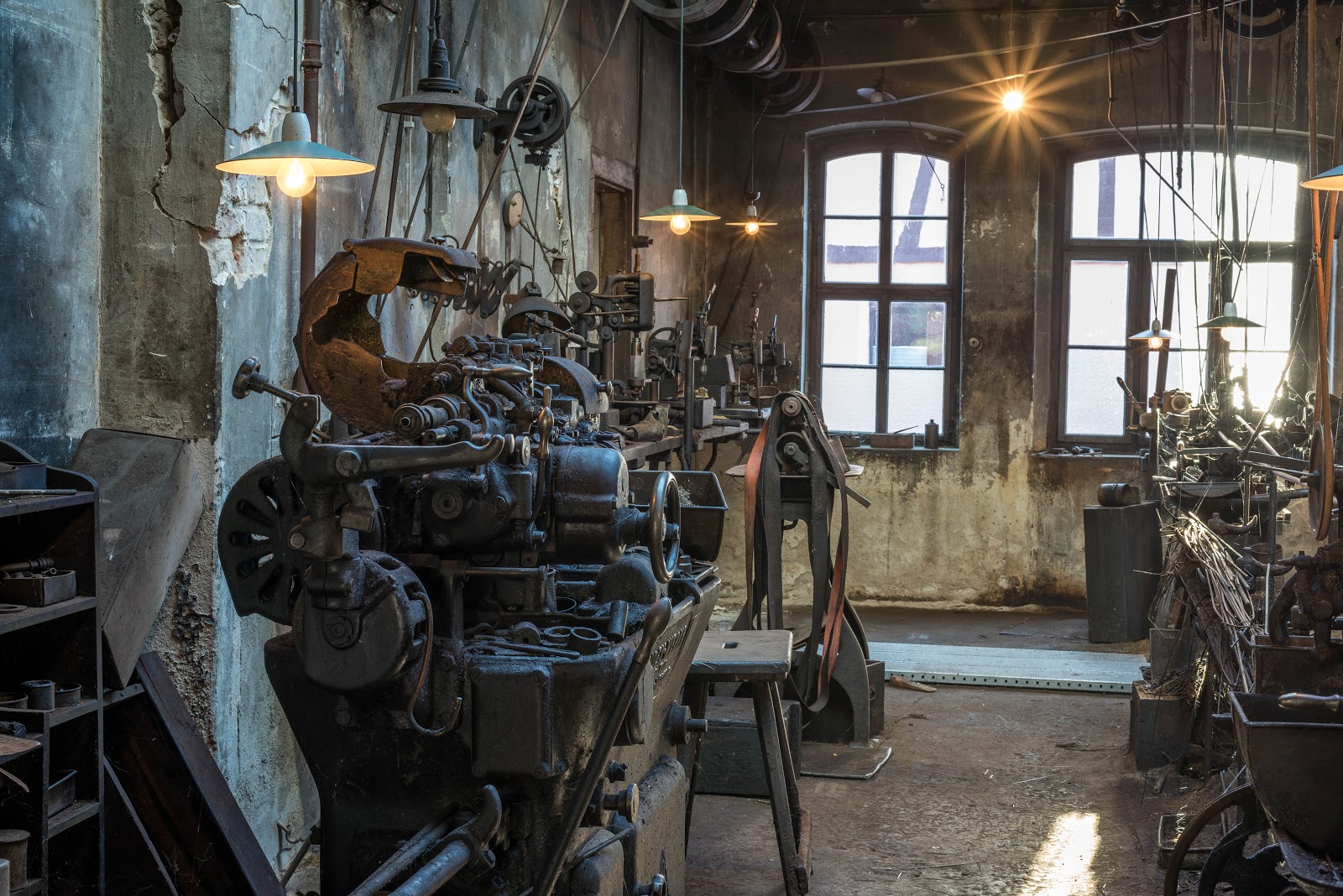
Lost places: The old screw factory


A few weeks ago, I had the opportunity to do a photo shoot in an old screw factory that had been empty for many years. A rather gloomy old factory building from several low halls. Fortunately, on this morning, the sun shone through the misty dusty windowpanes. But without my tripod I could not make the photos. I took more than two hours to look at every detail of the factory and capture it on my camera sensor. Sometimes I had the impression that the workers had just gone out for a little break. Everything lay around as if the work would continue. A wonderful morbid atmosphere! 
I will show you a selection of photos that have been created in this gloomy place. Actually you can probably photographed there for days and always discover new little things. Maybe I'll be back in the next few months and show you more pictures.  
I have photographed with a Nikon D610 and the lenses Nikon AF 24mm f/2.8 D, the Nikon AF-S 28mm f/1.8 and the Nikon AF-S 50mm f/1.8.